
Most people think of logic and intuition as opposites—like oil and water. In reality, they’re more like the left and right legs of your decision-making: you use both to move forward, just in different steps.
The real question isn’t which one is better, but which one you lean on without noticing. That hidden bias? It could be the reason some decisions work out brilliantly… and others don’t.
Do you rely on Intuition or Logic more? (Quick Assessment)
Let’s see which way you tend to lean. Pick the answer that feels most like you:

What is Logic?
Logic is the structured, fact-based way of thinking. It relies on evidence, step-by-step reasoning, and clear rules to arrive at a decision.
How it shows up
- Making a pros-and-cons list before deciding.
- Double-checking data or facts before acting.
- Preferring plans over spontaneity.
- Breaking a big problem into smaller, solvable chunks.
It’s not just about being “rational”; it’s about making sure each conclusion has solid ground to stand on.
Example
You’re buying a new phone. You compare prices, read reviews, check specs, and only after weighing all the facts, you decide which one to get.
What is Intuition?
Intuition is the instinctive, gut-driven way of thinking. It draws on experience, emotions, and subconscious patterns rather than step-by-step analysis.
How it shows up
- Saying “this feels right” without a spreadsheet to prove it.
- Sensing something’s off before you can explain why.
- Jumping into action without overthinking.
- Trusting your first impression of a person or situation.
It’s not magic, and it’s not random. It’s your mind quietly piecing together patterns from everything you’ve seen, heard, and felt… and serving you the answer in a split second.
Example
You’re at a bookstore. One cover catches your eye. You don’t read reviews or compare—something tells you this is the book for you, and you buy it.
Key Differences between Logic and Intuition

The Science Behind
Both intuition and logic come from the same brain — they just use different systems.
Intuition taps into the brain’s fast thinking mode (often linked to the limbic system), which processes patterns and experiences subconsciously. It’s quick, automatic, and often emotionally charged.
Logic uses the slow thinking mode (prefrontal cortex), where decisions are deliberate, analytical, and based on evidence.
When to Use Logic and When to Trust Intuition
Not all decisions are made equal—some call for careful thought, others demand quick action. Knowing which approach fits can save time and reduce stress.

Use Logic When:
- You’re dealing with something new or complicated.
- There’s time to dig into the facts and details.
- Getting it exactly right matters.
- You need to clearly explain your choice to others.
Trust Intuition When:
- You’ve been through similar situations before.
- You need to decide fast, especially under pressure.
- You don’t have all the info but still need to act.
- Reading people or emotions is part of the equation.
The trick is knowing which approach fits the moment and trusting both your head and your gut when they work together.
Which is Better?
The simple truth is: neither is better on its own. Logic and intuition serve different roles, and their real power comes when they work together.
Logic gives structure, clarity, and certainty. Intuition brings speed, creativity, and subtle insight. Alone, each has limits—but together, they complement and enhance each other, creating decisions that are both smart and instinctively right.
So the “better” approach isn’t choosing one—it’s learning to blend them seamlessly, letting your mind draw on both reasoning and gut feeling in harmony.
Why is it important to balance intuition and logic?
Relying too much on either logic or intuition can hold you back.
- Leaning only on logic can slow you down, causing analysis paralysis or missing the bigger picture.
- Depending solely on intuition risks jumping to conclusions or overlooking important details.
When you balance both, you get the best of both worlds: clear, confident decisions that feel right and make sense.
Strategies for Balancing Intuition and Logic
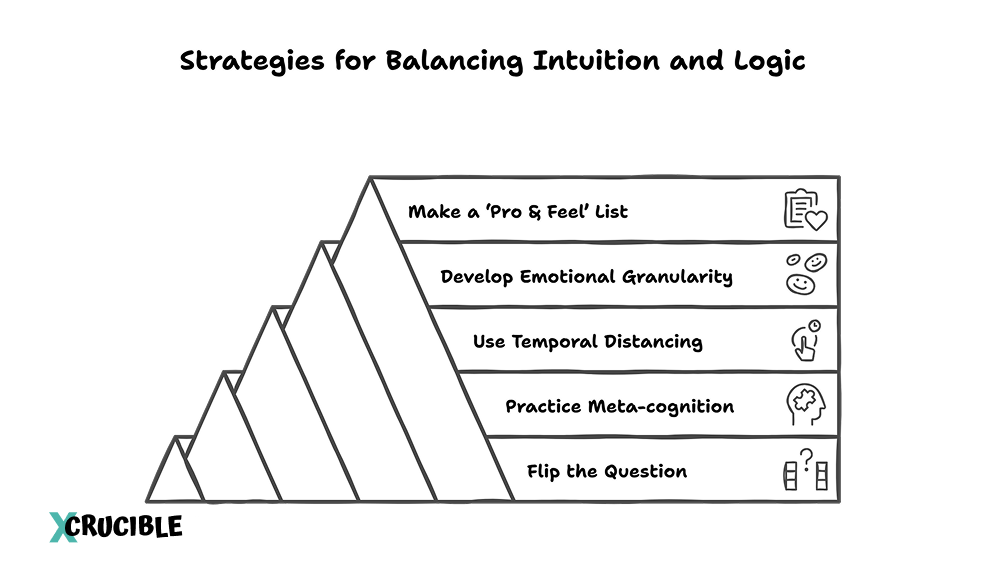
Here are some unique strategies to balance logic and intuition that dig deeper than the usual advice:
Flip the Question
Instead of asking, “What should I do?” try asking, “What if I do the opposite?” This surprises your brain and helps you notice feelings or facts you might have missed. It breaks your usual thinking and helps balance instinct and reason.
Practice Meta-cognition
Meta-cognition means thinking about your own thinking. Pay attention to when you rely more on intuition or logic, notice any biases, and decide consciously when to switch between or combine both modes. This creates a more self-aware and adaptable decision process.
Use Temporal Distancing
When stuck between intuition and logic, imagine how you’ll feel about the decision in a week, month, or year. This mental time travel taps into both emotional foresight (intuition) and analytical projection (logic), blending them for balanced clarity.
Develop Emotional Granularity
This means improving how precisely you identify your feelings. Instead of just feeling “good” or “bad,” try to label emotions like fear, excitement, or caution. The more detailed your emotional awareness, the better you can fine-tune your intuition to work with logic.
Make a ‘Pro & Feel’ List
Alongside the usual pros and cons, write a short note on how each option makes you feel. This simple practice helps your brain integrate emotional data from intuition with factual information from logic.
Real-Life Example
Imagine you’re thinking about starting a side project—maybe a small online store, a blog, or a creative venture.
Logical Approach:
You research the market, calculate costs, estimate potential revenue, and make a detailed plan. You check competitors, analyze trends, and create a step-by-step strategy. This method reduces risk and gives a clear roadmap, but it can feel overwhelming and slow down action.
Intuitive Approach:
You listen to your instincts—what ideas excite you most, what feels achievable, and where your passions naturally lie. You may sense a certain niche is right or a particular approach feels aligned with your skills. This approach is fast and taps into your experience, but it might miss practical challenges or hidden risks.
Balanced Approach:
You combine both: you do enough research to understand the market and risks, but you also follow your instincts on what excites you and feels meaningful. This way, you take action with confidence, guided by both practical reasoning and your inner sense of direction.
Every day, we make dozens of small decisions—most of them so routine that we barely notice how we choose. Yet in every one, logic and intuition quietly work together.
Even the little things show this balance: deciding when to speak up in a meeting, picking a route through traffic, or choosing a workout that challenges you but feels doable. You weigh what makes sense with what feels right, and the decision emerges naturally.
The Paradox Of Logical Intuition
At first glance, logic and intuition seem like completely opposite forces. Logic is deliberate and slow, while intuition feels fast and automatic. But the truth is more interesting: sometimes your intuition is actually a form of hidden logic.
This happens because your brain has a remarkable ability to absorb complex patterns and rules over time—often without you being aware of it. When faced with a decision, your subconscious quickly processes this vast background knowledge and delivers a gut feeling that feels instinctive but is rooted in real experience and logical structure.
For example, think about expert chess players who make lightning-fast moves without consciously calculating every possibility. Or doctors who spot subtle signs and make diagnoses in seconds. Their intuition isn’t guesswork—it’s their brain’s way of applying deep, practiced logic instantly.
Understanding this paradox helps us realize that intuition and logic are not enemies but partners. Intuition can be the output of complex logical processing happening beneath the surface. This means cultivating both, and knowing when to trust your gut can be just as important as careful reasoning.
Wrapping up
Think of logic as a flashlight and intuition as a shadow—you need both to see the full picture. Alone, each gives only a partial view. Together, they reveal possibilities you might otherwise miss.
The real insight? Your decision-making grows with you. The more you notice your instincts, check them against facts, and reflect on the outcomes, the better your inner dialogue becomes. Over time, this quiet practice turns into a natural skill—helping you make choices that feel right and make sense, even in situations that seem uncertain or messy.
It’s not about being perfect. It’s about letting your head and gut work together, so your choices feel grounded and sensible. That balance is what makes decision-making smoother and more reliable.