
Have you ever felt busy all day but wondered if you truly accomplished anything meaningful?
Productivity is often measured by how much we do — but what if we’ve been asking the wrong question all along? What if the real measure of productivity isn’t quantity, but meaning?
In today’s world of constant notifications, endless to-do lists, and perpetual multitasking, it’s easy to confuse motion with progress. That’s where intentional productivity steps in — not as another productivity hack, but as a way to work smarter, with clarity and purpose.
What is Intentional Productivity?
Intentional productivity is a shift in how we approach our work and daily life. It’s not about filling every minute with tasks or racing to check off endless lists. Instead, it’s about making conscious choices about where you invest your time, energy, and focus.
Think of it like steering a ship. Without intention, you’re at the mercy of waves and currents — constantly reacting to what comes your way. With intention, you chart your own course, deciding your destination and the path to get there.
At its core, intentional productivity is about clarity. It asks you to step back, evaluate your priorities, and align your actions with what truly matters. It transforms productivity from mindless busyness into purposeful progress.
Example:
Imagine two writers with the same goal — publishing a book in six months. One sits down every day and writes whatever ideas come to mind, juggling tasks and reacting to distractions. The other begins each week with a plan: defining what chapter to work on, blocking focused writing time, and removing distractions during those hours. At the end of six months, the second writer finishes a complete, polished draft. The first has lots of notes — but no book. This difference comes down to intention in how they approach their work.
Key Elements of Intentional Productivity
Intentional productivity isn’t a single habit or tool — it’s a system built on several core elements that work together. These elements create the foundation for making purposeful choices about how you spend your time and energy.
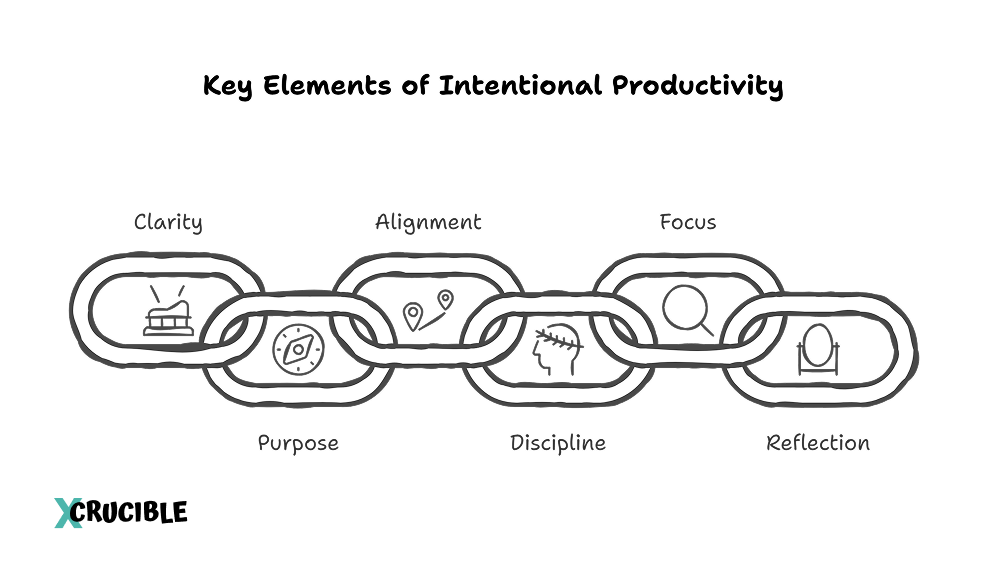
Here are the key elements:
Clarity
Clarity means having a clear sense of what matters most to you. When you know your goals and values, it’s easier to decide where to focus your time and energy. Without clarity, it’s easy to get caught up in doing things that don’t actually move you forward.
Purpose
Purpose is the reason behind your work. It’s the “why” that keeps you going when tasks feel long or challenging. Purpose transforms everyday actions into meaningful steps toward something bigger.
Alignment
Alignment means making sure your daily actions match your larger goals. It’s about asking yourself whether what you’re doing today supports where you want to go tomorrow.
Discipline
Discipline is about consistently making choices that support your priorities, even when it’s tempting to give in to distractions. It’s the bridge between intention and action.
Focus
Focus means giving your full attention to the task at hand. It’s resisting multitasking and being present with the work you’re doing now. Focus improves quality, reduces mistakes, and saves time in the long run.
Reflection
Reflection is the habit of stepping back to review what’s working and what isn’t. It allows you to refine your process so your productivity stays intentional over time.
These elements aren’t separate steps to tick off. They work together, creating a mindset and system where productivity is not just about doing more — it’s about doing what truly matters.
The Power of Intentional Productivity
Intentional productivity holds a transformative power that goes beyond efficiency. It reshapes the way we work, decide, and live.
- Transforms effort into meaningful results: Every action becomes a deliberate step toward something important.
- Sharpens decision-making: Clear intentions help you choose tasks that truly matter.
- Builds lasting focus: Encourages working with attention instead of distraction.
- Protects energy and wellbeing: Reduces burnout by prioritizing quality over quantity.
- Strengthens consistency: Intentional habits turn sporadic effort into steady progress.
- Aligns daily actions with bigger goals: Every day becomes a purposeful step forward.
The Science Behind
Intentional productivity works because it aligns with how our brains and bodies naturally operate. When you have a clear purpose, your brain spends less energy deciding what to do next. This reduces decision fatigue — the mental exhaustion that comes from too many choices — and frees up focus for the tasks that matter most.
Purpose also engages the brain’s reward system. When your actions connect to meaningful goals, dopamine is released, which increases motivation and helps you keep going even during challenging tasks.
Another important factor is energy alignment. Our energy levels naturally fluctuate throughout the day. Deep, focused work is most effective during peak energy hours, while less demanding tasks work better during low-energy periods. This natural rhythm is something intentional productivity taps into for better results.
Mindful attention strengthens this process. It helps reduce mental noise, improves concentration, and makes each task feel more deliberate. Over time, consistently practicing these habits creates strong mental patterns, turning intentional productivity into a natural way of working.
How to Practice Intentional Productivity?

1. Start with Clarity
Before anything else, get clear on what matters most. Intentional productivity begins with defining your goals and values. When your “why” is clear, you can make decisions that align with it. Start by asking yourself: What outcome do I want to achieve? Why is this important? Writing your answers down helps make them tangible.
2. Plan with Intention
Instead of letting tasks dictate your day, design your day around your priorities. Use time-blocking to dedicate specific hours to meaningful work, and guard those blocks fiercely. Planning isn’t just about listing tasks — it’s about giving each task a reason for being in your schedule.
3. Match Tasks to Energy Levels
Our energy fluctuates throughout the day. Intentional productivity means working in harmony with these cycles. Reserve your peak energy hours for high-focus work — tasks that need creativity, problem-solving, or deep thinking. Use lower-energy times for routine or administrative work. This approach not only improves efficiency but also keeps your energy balanced.
4. Limit Distractions
Distractions are one of the biggest obstacles to intentional productivity. Create boundaries that protect your focus. This could mean turning off notifications, setting specific times to check emails, or creating a dedicated workspace. The goal is to create an environment where your attention can remain on what matters most.
5. Practice Single-Tasking
Multi-tasking may feel productive, but it often reduces efficiency and quality of work. Intentional productivity is about fully engaging with one task at a time. Give each task your full attention, complete it, and then move on. This not only improves results but also makes your work feel more rewarding.
6. Reflect Regularly
Reflection is the habit that keeps intentional productivity alive. At the end of each day or week, take a moment to review your progress. Ask yourself: Did I focus on the right things? What worked well? What could be improved? Reflection helps you refine your approach and ensures your productivity stays aligned with your goals.
7. Build Consistency
The power of intentional productivity comes from making it a habit. Small, consistent actions over time create a momentum that transforms your work and life. Don’t aim for perfection — aim for deliberate progress.
Practicing intentional productivity is a journey. It’s about creating a rhythm where your actions are guided by clarity, energy, and purpose. Over time, this approach doesn’t just change how you work — it changes how you experience your work and your life.
Mindset Shifts for Intentional Productivity
Changing your mindset is at the heart of intentional productivity. These shifts reshape how you think about work, time, and priorities, creating a mental framework that supports focus and purpose.
- From “I have to do it all” → to “I choose what matters most”
This shift moves you away from feeling pressured to tackle everything and toward consciously selecting the work that aligns with your goals. It’s about making deliberate choices instead of reacting to every demand. - From “More is better” → to “Better is enough”
Instead of equating productivity with quantity, this shift encourages valuing quality over volume. It’s about focusing on doing fewer things exceptionally well rather than many things just adequately. - From “I work when I can” → to “I work when I’m most effective”
This means aligning work with your natural energy and attention cycles. It’s not about squeezing in work whenever possible but about choosing times when you can be most focused and creative. - From “Every task is urgent” → to “Not everything deserves my attention”
This shift helps you distinguish between true priorities and distractions disguised as urgent tasks. It encourages discernment and protects your time for what matters most. - From “Perfection is the goal” → to “Progress is the purpose”
This change releases the pressure to be flawless. It embraces learning and improvement, recognizing that small, consistent steps lead to lasting results. - From “Time is something to spend” → to “Time is something to invest”
This perspective reframes time as a valuable resource that can be invested wisely to create long-term value, rather than something to be endlessly consumed.
Adopting these mindset shifts doesn’t happen instantly. It’s an ongoing process of awareness, reflection, and conscious choice.
Overcoming Common Challenges
Even with a clear purpose and the right mindset, implementing intentional productivity can present obstacles. Recognizing these challenges and proactively addressing them is crucial for sustained progress.
1. Distractions and Overload
In today’s digital age, constant notifications and multitasking can fragment attention. To combat this:
- Create a dedicated workspace free from interruptions.
- Limit digital distractions by turning off non-essential notifications.
- Implement focus techniques like the Pomodoro Technique to maintain concentration.
2. Procrastination
Delaying tasks often stems from feeling overwhelmed or lacking motivation. Overcome this by:
- Breaking tasks into smaller, manageable steps to reduce the feeling of being overwhelmed.
- Applying the two-minute rule: If a task can be completed in two minutes or less, do it immediately.
- Setting clear, achievable goals to build momentum and confidence.
3. Lack of Motivation
Motivation can fluctuate, making it challenging to stay productive. To boost motivation:
- Set clear, attainable goals and celebrate small wins.
- Visualize the benefits of completing tasks to reinforce purpose.
- Establish a routine to create consistency and reduce decision fatigue.
4. Multitasking
Attempting to juggle multiple tasks can reduce efficiency and increase errors. To improve focus:
- Practice single-tasking, dedicating attention to one task at a time.
- Prioritize tasks based on importance and deadlines.
- Use time-blocking techniques to allocate specific periods for focused work.
5. Stress and Burnout
Chronic stress can impair cognitive function and productivity. To manage stress:
- Incorporate relaxation techniques such as meditation or deep breathing exercises.
- Maintain a healthy lifestyle with regular exercise, adequate sleep, and a balanced diet.
- Set realistic expectations and learn to say no to avoid overcommitting.
Real-World Example
Think about a typical day — you start with good intentions, maybe even a to-do list, but by evening, you’re left wondering where the time went. Your day felt full, yet not truly fulfilling. You were busy, but not necessarily productive.
Now imagine a different version of that day. You begin by identifying the few things that actually matter — the tasks that will move your goals forward. You block your most focused hours for deep, meaningful work, and push meetings or messages to a later time. Before starting any new task, you pause and ask yourself, “Is this worth my energy right now?”
Slowly, your days start to feel different. You get more done, but with less rush. You feel more in control, less scattered. You finish your day not just with completed tasks, but with a quiet sense of progress and clarity. That’s what intentional productivity feels like — a calm sense of direction in the middle of all the noise.
Wrapping Up
Intentional productivity isn’t about squeezing more hours into your day — it’s about filling your hours with what truly matters. It’s a shift from reacting to life’s demands to consciously directing your time, energy, and attention.
When you choose work that aligns with your purpose, focus becomes natural. Progress feels more satisfying. And the constant pressure to “do more” starts to fade away. You begin to measure your days not by how many boxes you tick, but by how much meaning you create.
So the next time you feel overwhelmed by the noise of busyness, pause and ask yourself: “Am I being productive — or just active?” The answer to that question might be the quiet start of something transformative.